Six of the eight mistakes below are made before a cafe opens, so a careful buyer can avoid most of them on paper. Under-reserving cash, signing the cheapest lease or hiring three weeks before launch sets up a hard first year that no operations manual can repair.
Each entry shows the mistake, why first-time owners make it and the fix. Clean Eatz, with its FDD dated April 30, 2026, is the worked example.
The short answer
Skipping due diligence, thin working capital, treating Item 19 averages as a promise, cheap-rent sites, late hiring, skipped validation calls, improvising on the system and delaying local marketing. Each has a fix you can start before you sign.
Why a first-time franchise owner stumbles
The stakes in the first five years
Most franchise mistakes are ordinary small business mistakes made with more money at stake. A franchise supplies the brand and the operating system. Cash discipline and a well-chosen lease remain your job, and that is where a first time franchise owner usually gets hurt.
Of the private-sector establishments that opened in the year ended March 2025, 78.9% were still operating in March 2026, according to the Bureau of Labor Statistics. Of those that opened in the year ended March 2021, 47.2% were still operating five years later, in March 2026.
- 78.9%of private-sector establishments opened in the year to March 2025 still open in March 2026BLS Business Employment Dynamics, 2026
- 85.3%one-year survival for accommodation and food services establishments, same opening yearBLS Business Employment Dynamics, 2026
- 56.3%of accommodation and food services establishments opened in the year to March 2021 still open in March 2026BLS Business Employment Dynamics, 2026
One caution: BLS counts establishments rather than franchises, and its accommodation and food services table includes hotels. For a single brand, its own disclosure document is the better source.
If you are a first time business owner, use the list as a pre-opening checklist. Most of these fixes cost a phone call or a spreadsheet, provided you make them before you sign.
Skipping franchise due diligence
Read the document before the brand sells you
A buyer tours a cafe, likes the founders, then skims the Franchise Disclosure Document for the fee and the royalty. That document runs to 23 Items plus exhibits, and the skimmed parts tend to be the ones describing risk.
Familiarity breeds the shortcut. Federal rules buy you time: the FTC’s buyer guide says you must receive the document “at least 14 days before you are asked to sign any contract.”
The fix
Treat franchise due diligence as a reading list. Spend those 14 days on these Items with a franchise attorney and an accountant, and write down every question the document leaves open.
- Items 5 & 6: the initial fee and every recurring fee
- Item 7: the estimated initial investment, line by line
- Item 11: training and opening assistance
- Item 12: what the territory protects
- Item 19: financial performance, plus the notes under it
- Item 20: three years of openings and closures, plus former owners
- Item 21: the franchisor’s financial statements
The SBA tips on buying a franchise make the same point about disclosure documents and contract terms. Clean Eatz keeps a page of Franchise due diligence resources, exploring the brand costs nothing until you sign a franchise agreement, and Step 4 of its process is the FDD review with your attorney and accountant.
Running short on working capital
Fund the slow months before they arrive
An owner funds the build-out to the last dollar, opens on schedule, then spends the first quarter juggling payroll against the food order. The cafe has not reached regular volume yet, and the bank account was sized for opening day.
Item 7 looks complete, which is why it gets trusted. Its additional funds line covers an initial period that the federal disclosure rule sets at “at least three months or a reasonable period for the industry.” That money pays the business, not your mortgage, and the FTC guide tells buyers to estimate “your personal living expenses for up to two years.”
How to fix it. Build a working capital plan in layers, then ask your CPA and lender to test it:
| What it covers | Where to find it | |
|---|---|---|
| Additional funds | Business costs in the first months | Item 7 of the FDD |
| Ongoing fees | Royalty and marketing on every sale | Item 6 of the FDD |
| Loan payments | Principal and interest from month one | Your lender’s term sheet |
| Household costs | Your bills while the cafe pays you nothing | Your budget, up to two years |
| Reserve | A slow ramp or a costly repair | Agreed with your CPA |
Where Clean Eatz lands
- Additional funds $20,000 to $40,000 for the first 3 months
- Fees per $100,000 of sales At least $9,000, plus $638 a month for technology
- Liquidity to qualify $250,000 for a single cafe
Read the Additional funds in the startup table, part of the $307,500 to $733,500 Item 7 range, and decide with your CPA how much of your liquid cash stays untouched after opening.
Reading averages as a promise
An average sits in the middle of a wide spread
A buyer finds average gross sales in Item 19, assumes a new cafe will land there and builds a loan application around it. Averages summarize many markets, and some locations sit well below them.
Item 19 is where a franchisor has to put any performance claim. In the FTC’s words, “Any claims the franchisor makes about sales, income or profits must be in Item 19.” Read the notes under the table as closely as the figures.
Clean Eatz publishes both ends on purpose. In 2025, across 92 franchised cafes open at least 18 months, average gross revenues were $1,030,285 and the median was $962,325. Of those cafes, 40 (43%) met or beat the average. The highest reported $2,053,793 and the lowest $389,339.
Average gross revenues by quartile, 2025
Item 19, Clean Eatz FDD dated April 30, 2026. 23 cafes per quartile. Gross revenues, not owner income.
Average EBITDA was $128,312, stated before owner and manager salary and before debt service, depreciation and taxes. As the brand puts it, “These are gross revenues, not owner income,” and the spread “reflects market, site quality, and operator engagement.”
*Financial performance representation. These figures are taken from Item 19 of the Clean Eatz Franchise Disclosure Document dated April 30, 2026, and reflect January 1 through December 31, 2025. They represent 92 franchised restaurants open at least eighteen months as of December 31, 2025 and operated by the same franchisee throughout the period. EBITDA is stated before owner and manager salary. These are historical results for existing locations. They are not a projection or guarantee of what you may earn. Your results may differ, and there is no assurance you will do as well. Written substantiation is available upon request. See Item 19 of the FDD for complete information.
The fix
Read Item 19 as a range. Ask owners in validation what put their cafe where it is, then have your accountant test your plan against the low end before the middle.
Picking a site for cheap rent
A cheap lease can cost more to build
The lease goes to the lowest of three rents, in a center with thin daytime traffic or a shell that needs everything. Rent is easy to compare. Build-out, visibility and parking are harder to price.
In the Clean Eatz Item 7, rent or real estate before opening runs $2,500 to $18,000, against $100,000 to $343,000 for construction, the largest line. A space that saves a little each month but needs heavy work can cost more up front than the lower rent returns in years.
The FTC adds that “many franchisors retain the right to approve sites for their outlets, and may not approve a site you select.” So let the franchisor’s criteria lead, and weigh rent and build-out together. Ask of any site:
- Can a weekly Meal Plan customer park, pick up and leave in a few minutes?
- Does steady daytime traffic pass the door of a cafe that closes around 7pm?
- What will the landlord put toward build-out?
- Is it within about an hour’s drive of your home?
How Clean Eatz handles it
- Site step Step 8, Find Your Site
- Support Real estate & construction team
- Footprint Roughly 1,800 to 2,400 square feet
Site selection is the last stop on the Eight-step path to opening, after the agreement is signed.
Hiring too slowly before opening
Staff the opening before you need it
Jobs go up three weeks before opening, the owner hires whoever applies, and the crew learns the menu during soft opening with real customers watching.
Payroll before revenue feels wasteful, so first-timers wait, and the labor market punishes it. In the BLS Job Openings and Labor Turnover Survey, quits in accommodation and food services averaged 4.2% of workers a month in 2025, close to double the private-sector 2.2%. Hires ran at 5.5% a month against 3.6%. A new cafe hires from its first day and rarely stops.
The fix
Hire ahead of the date and expect some people not to stay. Pick one or two shift leads early, train them first and let them help train the rest.
Leads who grow into managers repay the early payroll. One Clean Eatz owner walked that path:
I started as a store manager and worked my way up to owning two locations.
Dylan Richmond, 2 locations, Virginia
Where the model helps
- Owner training 10 Days at HQ in Wilmington, one on one
- Opening week On-site Grand Opening Support
- Shifts to cover Roughly 11am to 7pm, no fryers
Skipping the validation calls
Owners will tell you what the FDD cannot
Two owners suggested by the franchisor get a call, both say they like the brand, and the buyer counts that as validation.
In the FTC’s view, “Talking to these people may be the most reliable way to verify the franchisor’s claims.” Item 20 lists current owners and, by federal rule, those who left in the last fiscal year. Call some of both.
Ask questions with numbers in the answer. A starting list, adapted from the FTC’s suggestions:
- What was your total investment against the Item 7 range?
- How long did it take to open after you signed?
- How useful were the training and the opening help?
- What does the franchisor still do for you a year or more in?
- Are you happy with the cost and quality of required supplies?
- Would you buy another location?
Clean Eatz calls validation “the most important step in the process” and says “we don’t screen who you speak with.” Talk to owners before you sign, then use Discovery Day in Wilmington to meet the departments behind the brand.
Going off the playbook
The system only works if you run it
A new owner adjusts a recipe for local taste, swaps a supplier or trims the prep checklist on a busy day. Each change seems small. Stacked together, they make the cafe harder to run and harder to support.
Owners buy a business to make their own calls. The FTC flags the tension up front: franchisors “usually control how franchisees conduct business,” and those controls “may significantly restrict your ability to exercise your own business judgment.”
Red flag
If you already plan to change the menu, the hours or the suppliers, the concept may not fit you. Choose a system you are willing to run as written.
Run the system exactly for the first months, keep a list of what you would change and take it to the operations team. At Clean Eatz, On Demand Training holds the operating standards, recipes and daily checklists, and the Ops & Marketing Team coaches owners after launch.
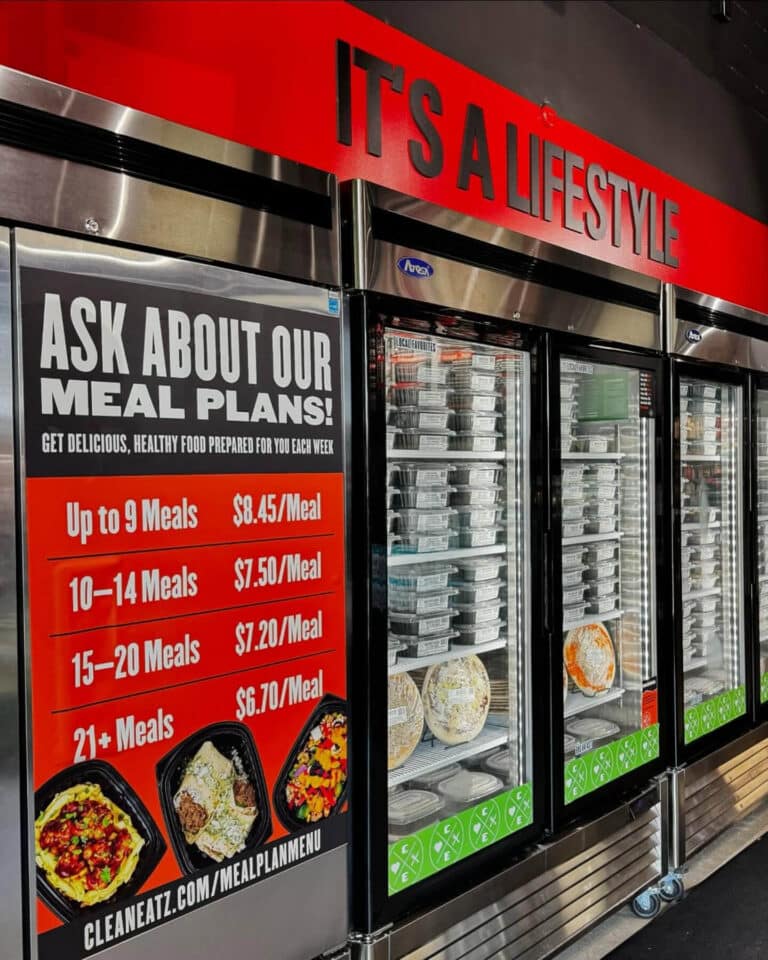
Consistency carries extra weight here. Meal Plan customers return weekly, so a skipped step shows up at the pickup counter.
Leaving local marketing until later
Your first regulars live nearby
Some owners count on the brand name to fill the cafe and start local outreach only once sales look soft.
They assume the brand fund covers it. The FTC notes you “may have to contribute to an advertising fund,” and Item 11 describes how it is spent. Local spending can be a separate minimum, as it is at Clean Eatz, so read Item 6 for both.
Start before you open. Meet the gyms and offices within a short drive, book catering tastings and set a weekly local budget you keep in slow weeks. The Clean Eatz FDD lists these lines:
- Local marketingAt least 1% of gross sales, $1,000 per $100,000
- Brand fund2% of gross sales, $2,000 per $100,000
- Opening spend$2,000 to $7,000 for 3 months of advertising, plus $5,000 in initial marketing funds
Fitness businesses make natural first partners for a healthy cafe. Two Ohio owners came from that side of the counter:
Clean Eatz let us hand them a real, tangible solution instead of advice.
Anna & Michael Dey, 2 locations, Ohio
What franchise success looks like in year one
What a good first year looks like
Franchise success in year one is quiet: the cafe opened near budget, the reserve lasted and regulars came back each week. These franchise tips put the eight mistakes in one view.
| Warning sign | The fix | |
|---|---|---|
| Due diligence | You can quote the fee, not Item 20 | Read the FDD with an attorney |
| Working capital | Reserve equals the Item 7 line | Add household costs |
| Averages | Plan starts from the average | Test the bottom quartile |
| Site | Cheapest rent won | Weigh build-out too |
| Hiring | Jobs posted weeks before opening | Hire leads early |
| Validation | Only suggested owners called | Call former owners too |
| Playbook | Menu edits already planned | Run it as written first |
| Local marketing | No plan before opening week | Book partners early |
A healthy franchise model can make some of this easier. At Clean Eatz that means a roughly 11am to 7pm day, no fryers, five revenue streams and 10 Days at HQ training in Wilmington. The work remains yours. Owners live within roughly a one-hour drive of their cafe, because “it isn’t designed as an absentee investment.”
Own a Clean Eatz Cafe
From $307,500 all-in
See Item 7
If you are weighing a healthy franchise, the next step is a conversation. Explore the Opportunity and bring this list with you.
Sources
- Establishment survival by opening year, total private, BLS, 2026
- Establishment survival, accommodation and food services, BLS, 2026
- JOLTS annual quits rates, BLS, 2025
- JOLTS annual hires rates, BLS, 2025
- A Consumer’s Guide to Buying a Franchise, Federal Trade Commission, 2020
- 16 CFR 436.5, Franchise Rule disclosure items
- Buy an existing business or franchise, SBA
- Why Restaurants Fail, Parsa, Self, Njite & King, Cornell Hotel and Restaurant Administration Quarterly, 2005
Common questions about franchise mistakes
Straight answers on failure & cash
What is the franchise failure rate?
There is no official franchise failure rate, because no federal agency publishes one. A 2005 study by Parsa and colleagues tracked 2,439 restaurant licenses in Columbus, Ohio from 1996 to 1999 and found three-year ownership turnover of 57.2% for franchise chains and 61.4% for independents, a gap the authors called “marginal.” It counted any change of owner as a failure, so sales and transfers sit beside closures. For one brand, read Item 20 of its FDD, which tables three years of openings, terminations, transfers and closures.
Why do restaurants fail in the first year?
No federal dataset records why restaurants fail, so treat any single-cause answer with care. What a new owner controls is on this list: cash, site, staffing and local marketing. The “90% fail in year one” line comes from a 2003 American Express TV ad, and the 2005 Parsa study reports that the company could not supply data to support it. BLS data shows 85.3% of accommodation and food services establishments opened in the year to March 2025 still operating in March 2026.
How much working capital should you hold back?
Start with the additional funds line in Item 7, then add loan payments, a reserve and your living expenses, which the FTC suggests estimating for up to two years. At Clean Eatz that Item 7 line is $20,000 to $40,000 for the first three months. Set your own figure with a CPA.
Do you need restaurant experience to own a healthy franchise?
Not at Clean Eatz. Restaurant, fitness, manufacturing and military service at E-5 or above all fit, none is required, and in the brand’s words “mission alignment matters most.”