One survey supplies the most-cited answer to what a restaurant costs to open. RestaurantOwner.com asked more than 350 independent owners in 2018 and reported a median startup cost of $375,000. That is what owners said they spent across very different buildings, a benchmark rather than a budget.
A franchise gives you something an independent never gets: a written estimate. Federal rules require every franchisor to publish its estimated initial investment, line by line, in Item 7 of the Franchise Disclosure Document. Below, the independent benchmarks sit beside one real Item 7, from Clean Eatz, a healthy cafe franchise.
Key stats
- $375,000median independent restaurant startup cost, 2018 survey
- 16 daysmedian cash buffer at small restaurants, 2016 study
- $307,500low end of the Clean Eatz Item 7 range
- 56.3%food service and lodging locations still open after 5 years, BLS
The short answer
An independent restaurant has no standard price: the best-known survey put the 2018 median at $375,000. A franchise discloses its own range in Item 7. For a Clean Eatz cafe that is $307,500 to $733,500, including the $49,500 franchise fee, excluding real estate purchase and ongoing fees.
Restaurant startup costs at a glance
The benchmarks buyers ask about first
Restaurant startup costs get reported two ways: what owners say they spent, and what a franchisor must disclose. The cards below are the first kind. Read the year and the sample before you lean on any of them.
- $375,000Median startup cost, independent restaurantsRestaurantOwner.com, 2018, 350+ owners
- $650,000Median new construction, real estate excludedRestaurantOwner.com, 2018
- $63,598Average amount owners went over budgetLightspeed survey of 246 operators, 2025
- 16 daysMedian cash buffer days, restaurantsJPMorgan Chase Institute, 2016
So how much does it cost to start a restaurant in 2026 dollars? Carried forward with the Consumer Price Index from November 2018 to September 2026, the 2018 median of $375,000 works out to about $501,000. That adjusts for general inflation only. Construction, equipment and rent each moved at their own pace, so treat it as a reference point, not a quote.
How much does it cost to open a restaurant?
A range set by the building you choose
How much does it cost to open a restaurant? Start with the building, not the menu. In the 2018 survey, the cost to open a restaurant more than doubled between taking over an old restaurant space and building from the ground up.
That is why an average cost to open a restaurant hides more than it shows. Two owners with the same concept can land far apart because one inherited a hood, a walk-in cooler and plumbing in the right places. The other paid to put them there.
Average cost to open a restaurant by type
Second-generation space is the cheapest door in
Median startup cost by building type, 2018
Source: RestaurantOwner.com 2018 Cost to Open a Restaurant Survey, 350+ independent owners. Medians as reported.
Service type moves the bill too, mostly through pre-opening spending. Restaurant Dive’s report on the survey listed median pre-opening and training costs of $12,000 for limited-service restaurants, $20,000 for bars and $25,000 for full-service restaurants. More staff to train before day one means more payroll before the first sale.
Build-out, equipment & pre-opening costs
Where most of the money goes
Build-out swings the most, because it depends on what the landlord hands you. Equipment is next. In Lightspeed’s 2025 survey of 246 U.S. operators, new owners spent an average of $38,801 on equipment, 45% bought or leased used equipment and 42% leased. Those are self-reported figures from a vendor’s own survey.
The SBA’s list of common startup costs covers space, equipment, utilities, licenses and permits, insurance, legal and accounting help, inventory, salaries and marketing. It also suggests padding the numbers by about 10% for miscellaneous expenses you can’t predict.
Working capital most owners underestimate
The money you need after the doors open
An average overrun of $63,598 hurts more in a restaurant than in most businesses, because restaurants run thin on cash. A 2016 JPMorgan Chase Institute study of 597,000 small businesses found the median restaurant held 16 cash buffer days, the fewest of the 12 industries measured. Across all small businesses, the median was 27.
Plan the reserve against that. The FTC’s buyer guide tells buyers to estimate operating expenses for the first year and personal living expenses for up to two years.
Food service & lodging locations still open, opened April 2020 to March 2021
Source: BLS Business Employment Dynamics, Table 7, Accommodation and Food Services (NAICS 72), as of each March through 2026.
Red flag
A startup budget with no line for the first months of payroll, rent and food cost. Item 7 makes franchisors show this as “additional funds.” An independent plan should carry it too.
How much does it cost to open a cafe?
Smaller rooms, lighter kitchens, lower floors
How much does it cost to open a cafe? Usually less than the survey’s median restaurant of 3,070 square feet and 120 seats, because a cafe has fewer square feet, fewer seats and a lighter kitchen. No cafe-only national survey with a published method was found, so here is a yardstick instead.
At the 2018 median of $113 per square foot, a 1,800 to 2,400 square foot cafe comes to roughly $203,400 to $271,200 in 2018 dollars, or about $272,000 to $363,000 after the same CPI adjustment. That is a scale check only.
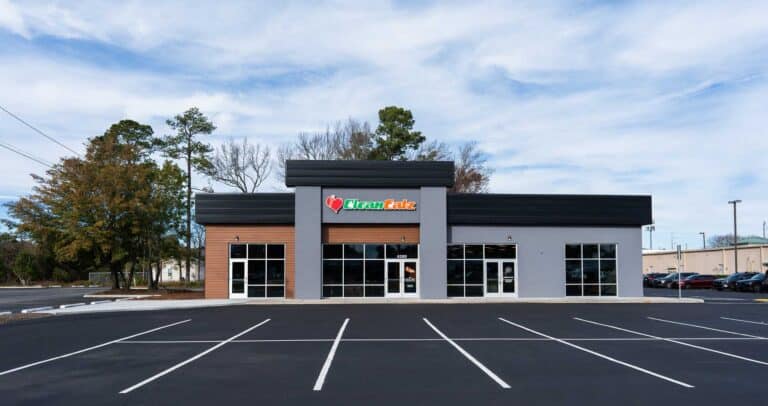
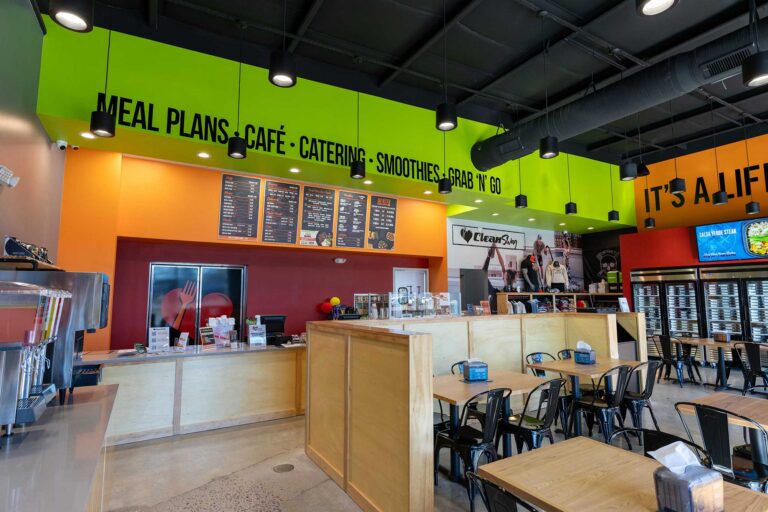
A fryer usually brings hood, fire-suppression and oil-handling requirements with it. Clean Eatz cafes run without fryers, and the brand puts it plainly: “No fryers means a smaller, simpler equipment package.” Its cafes sit in roughly 1,800 to 2,400 square feet and keep roughly 11am to 7pm hours, so the space, the equipment list and the crew are sized for a condensed day.
How much does it cost to open a franchise?
The franchisor has to show its math
How much does it cost to open a franchise? The FTC’s Consumer’s Guide to Buying a Franchise says the initial fee alone “will typically range from tens of thousands of dollars to several hundred thousand dollars,” before the cost to rent, build and equip an outlet. Of the full cost to open a franchise, that fee is the smallest part.
A restaurant franchise cost is usually higher than the fee suggests. Unlike an independent, though, you do not have to guess. Each brand publishes its range, and you can read three FDDs side by side before you sign anything.
Franchise initial investment explained
What federal rules say Item 7 must show
Item 7, the franchise initial investment, is defined by the FTC Franchise Rule, 16 CFR 436.5(g). Item 7 must be a table titled “YOUR ESTIMATED INITIAL INVESTMENT” showing each type of expense, the amount, how it is paid, when it is due and to whom. Where an amount is unknown, the franchisor gives a low to high range based on its current experience.
It must also carry an “Additional funds” line for costs before opening and during an initial period, which the rule says should be at least three months or a reasonable period for the industry. Item 5 covers initial fees and Item 6 the ongoing ones, such as royalties.
Restaurant franchise cost line by line
Use this as your Item 7 worksheet
Bring these questions to every brand you compare.
| Item 7 line | What to ask |
|---|---|
| Initial franchise fee | Is any of it refundable, and when? |
| Training expenses | Who attends, for how long, and where? |
| Real property | Is buying real estate excluded from the total? |
| Equipment, construction, leasehold improvements | What drove the high end of the range? |
| Opening inventory | Which suppliers are required or approved? |
| Deposits, licenses, prepaid costs | Is insurance shown for a full year? |
| Additional funds | How many months, and based on what experience? |
Compare like with like
Before you put two franchise ranges side by side, check that both cover the same initial period and treat real estate the same way.
Healthy food franchises vs independent startup costs
One disclosed range against one survey median
Healthy food franchises make a useful test case. Below, the franchise startup costs come from one brand’s Item 7, and the independent figures are survey medians.
| Independent restaurant | Franchise (Item 7) | |
|---|---|---|
| Source of the number | Your estimate, or a survey median | The franchisor’s disclosed range |
| Initial fee | None | Paid to the franchisor at signing |
| First months of operating cash | Only if you budget it | Required line, at least three months |
| Ongoing fees | None to a franchisor | Royalty and fund contributions in Item 6 |
| Who you can ask | Other independents, if they will talk | Current owners, listed in the FDD |
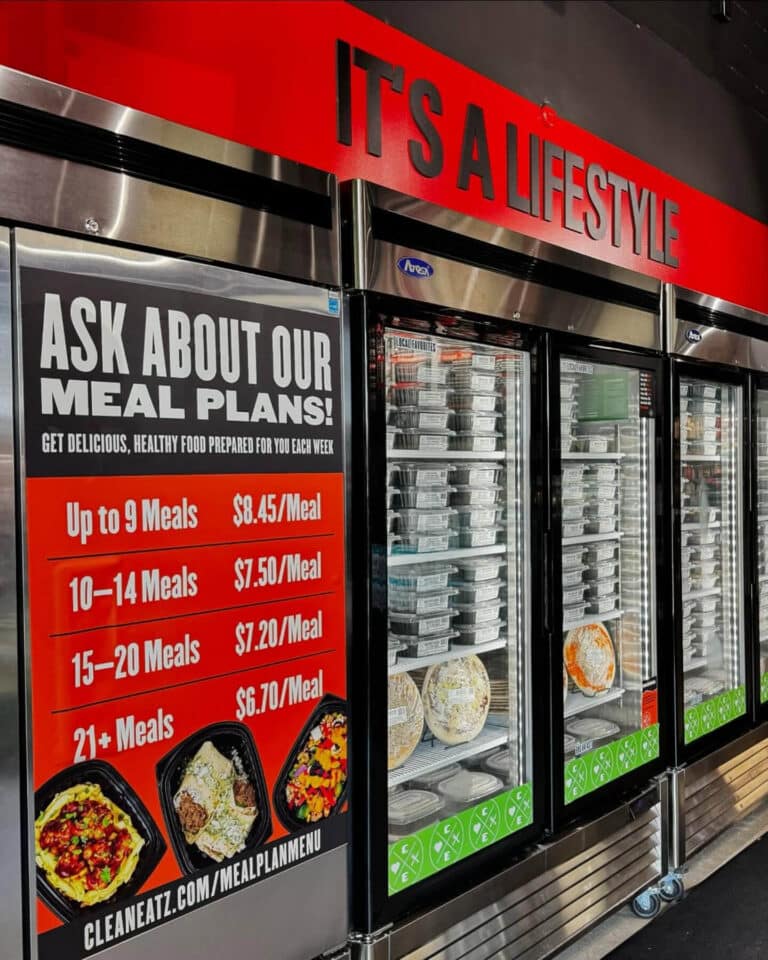
Anyone can read the Clean Eatz franchise initial investment on the brand’s site, line by line. Those lines follow the model: five revenue streams (Meal Plans, Grab-N-Go Meals, In-Store Cafe, Retail and Catering) run from one compact cafe, part of what makes meal prep franchises different from a dinner-driven restaurant. In the steps to own a Clean Eatz, reviewing the FDD comes at step 4, before any money changes hands.
The Clean Eatz initial investment range
$307,500 to $733,500, in 17 lines
Here is the full table from Item 7 of the Clean Eatz Franchise Disclosure Document dated April 30, 2026.
| Type of expenditure | Low | High | When due | Paid to |
|---|---|---|---|---|
| Initial franchise fee | $49,500 | $49,500 | At signing | Clean Eatz |
| Travel & living expenses | $500 | $2,000 | During training | Airlines, hotels |
| Rent or real estate | $2,500 | $18,000 | Prior to opening | Lessor |
| Cafe construction | $100,000 | $343,000 | Prior to opening | Contractors |
| Furniture | $4,000 | $5,000 | Prior to opening | Vendors |
| Signage | $3,000 | $11,000 | Prior to opening | Vendors |
| Miscellaneous opening costs | $1,000 | $2,500 | Prior to opening | Suppliers, utilities |
| Initial inventory | $10,000 | $18,000 | Prior to opening | Approved suppliers |
| Equipment | $60,200 | $156,500 | Prior to opening | Equipment vendor |
| Advertising / marketing (3 months) | $2,000 | $7,000 | Pre-open + first 3 months | Distribution service & media |
| Insurance (yearly) | $2,500 | $10,000 | Prior to opening | Insurance agent |
| Technology package | $8,700 | $12,000 | Prior to opening | Vendors |
| Additional funds (first 3 months) | $20,000 | $40,000 | As incurred | Suppliers, advisors |
| Initial marketing funds | $5,000 | $5,000 | Pre-open + first 2 months | Clean Eatz |
| Opening food order | $20,100 | $28,500 | Prior to opening | Vendors |
| Architect fee | $15,000 | $22,000 | Prior to opening | Architect, general contractor |
| Footprint design fee | $3,500 | $3,500 | Prior to opening | Architect, general contractor |
| Total | $307,500 | $733,500 |
Under the table, the site notes that these are estimates only, actual costs vary by market, site, construction and lease terms, and the figures do not include real estate purchase or ongoing fees.
The largest Clean Eatz Item 7 lines, high end
Source: Clean Eatz FDD dated April 30, 2026, Item 7. High end of each line.
What the range includes & leaves out
Read the footnote before the total
Construction is the biggest single line, $100,000 to $343,000, about 33% of the low total and 47% of the high. Construction and equipment together run $160,200 to $499,500, so when one cafe lands near $307,500 and another near $733,500, look at the space before the fee. By comparison, the $49,500 franchise fee is about 16% of the low total and about 7% of the high.
- IncludedThe franchise fee, rent before opening, build-out, equipment, opening inventory, a year of insurance and $20,000 to $40,000 in additional funds for the first 3 months.
- Left outBuying real estate, and the Item 6 fees: 6% royalty, 2% brand fund, at least 1% local marketing and $638 a month for technology.
- Per $100,000 of salesThe percentage fees come to at least $9,000 on every $100,000 of gross sales, plus the tech fee.
- To qualify$1,000,000 net worth and $250,000 liquid for one cafe, $2,250,000 and $600,000 for a three-unit development.
Set the additional funds line against the FTC’s advice to estimate a full year of operating expenses. Item 7 shows the franchisor’s estimate for 3 months, and your own reserve can reasonably be larger. Ask owners in validation how long their cafe took to settle into a steady week.
Paying for restaurant startup costs
Loans, retirement funds or leases
Begin with the SBA guide to startup costs, which includes a worksheet and the funding routes that follow from it: loans, your own money, investors and SBA-guaranteed loans found through Lender Match. Lenders compare your expected costs with projected revenue, so an itemized budget comes first.
SBA loans, ROBS & equipment financing
Three tools with different rules
| Route | Ceiling | Can pay for | Watch for |
|---|---|---|---|
| SBA 7(a) | $5 million | Working capital, equipment, real estate | Terms set by the lender |
| SBA 504 | $5 million to $5.5 million (SBA cites both) | Real estate, equipment with 10+ years of life | No working capital or inventory |
| SBA microloan | $50,000 | Working capital, inventory, equipment | No real estate, 7-year maximum |
| ROBS | Your retirement balance | Start-up costs, through a C corporation | IRS rules, annual Form 5500 |
| Equipment lease | Set by the lessor | Kitchen and other equipment | Total cost over the lease term |
A ROBS (rollovers as business start-ups) uses retirement money to buy stock in your new C corporation. According to the IRS, these plans are not considered abusive tax avoidance but are “questionable because they may solely benefit one individual,” and its compliance project started with ROBS sponsors that had not filed the annual Form 5500. Have a CPA and an attorney review any ROBS before you move a dollar.
Clean Eatz does not lend. It is SBA-friendly and can point buyers to lenders experienced with franchise loans, but loan terms and approval are set only by the lender.
Sources & methodology
Where every number came from
This article uses primary sources where they exist: the FTC rule and buyer guide, SBA program pages, the IRS, BLS survival and price data and the Clean Eatz FDD as published on its site. RestaurantOwner.com (2018) and Lightspeed (2025, 246 operators) are self-reported surveys. The inflation figures use CPI-U, not seasonally adjusted, from November 2018, when the survey was released, to September 2026: 252.038 to 336.940, a factor of about 1.34.
BLS survival covers accommodation and food services together, hotels included, for locations opened in the year ended March 2021. For the full picture of the brand, request the franchise business guide and the FDD, and review both with your attorney and accountant.
Sources
- RestaurantOwner.com cost to open survey release, PR Newswire, 2018
- Restaurant remodels still cost less than building, Restaurant Dive, 2018
- Navigating restaurant cost control, Lightspeed, 2025
- Cash Flows, Balances, and Buffer Days, JPMorgan Chase Institute, 2016
- Survival of establishments, Accommodation and Food Services, BLS, 2026
- CPI-U, U.S. city average, BLS, 2026
- 16 CFR 436.5, eCFR
- A Consumer’s Guide to Buying a Franchise, FTC, 2020
- Plan your business, SBA
- 7(a) loans, 504 loans and microloans, SBA
- Rollovers as Business Start-Ups Compliance Project, IRS
- Investment & Earnings, Clean Eatz Franchising, FDD dated April 30, 2026
Restaurant startup cost FAQ
Quick answers before you build a budget
Is it cheaper to open a franchise or an independent restaurant?
Not automatically. A franchise adds an initial fee and ongoing fees that an independent never pays. An independent pays in other ways, such as untested build-out choices or a thin reserve. Compare the same size space, and check each franchise against its own Item 7.
What is the franchise fee at Clean Eatz?
Clean Eatz charges a $49,500 initial franchise fee, paid at signing. It is part of the $307,500 to $733,500 Item 7 estimated initial investment. Service members at E-5 rank or above qualify for a reduced fee.
How much liquid capital do you need?
For one Clean Eatz cafe, $250,000 in liquid assets and $1,000,000 in net worth. A three-unit development calls for $600,000 liquid and $2,250,000 net worth. Your lender will set its own equity requirements on top of that.
Does Item 7 include working capital?
Yes, as the “additional funds” line, which the FTC rule says should cover at least three months or a reasonable period for the industry. At Clean Eatz it is $20,000 to $40,000 for the first 3 months.